
[New Post] Films “No Other Land” & “From Ground Zero: Stories from Gaza”
Outside Rialto Cinemas in Sebastopol, the woman who had heard me crying in the restroom stall asked if she could hug me.
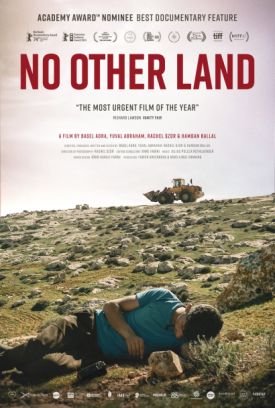
We had just seen the Oscar-winning film for Best Documentary No Other Land. The 30 attendees in the small theater had been absolutely silent afterward, and indeed all during the screening. I was alone in my out-loud reaction to the more sadistic scenes of Israeli army bulldozers demolishing a modest village school building, a home and its chicken coop, a water tank.
“Give me a fucking break!” is what I said into the void.
Maybe the audience was simply overcome. “Hard to watch” is what a gentleman whose gaze I finally caught after I’d had my cathartic cry and was wiping my eyes. Hard to watch and hard to accept that my tax money is helping to make the Palestinians of the occupied West Bank community of Masafer Yatta so miserable. For years on end.
This movie documented repeated home demolitions and encroaching Israeli settlements (complete with their gun-toting settlers) not in Gaza, which has been making more U.S. headlines since 2023, but in the West Bank. I read that since January three refugee camps there have been all but destroyed, making the people flee once again (40,000 displaced in Jenin, Tulkarm, Nur Shams) and killing an unknown number in the process.
In the style of that word-salad master and demolisher of meaning President #47, (“Gulf of America,” “Red-White-and-Blue Land”), Republicans now want to call this area by the Biblical Jewish names of Judea and Samaria. (Source: B’Tselem, posted 11 March 2025 on reliefweb.int )
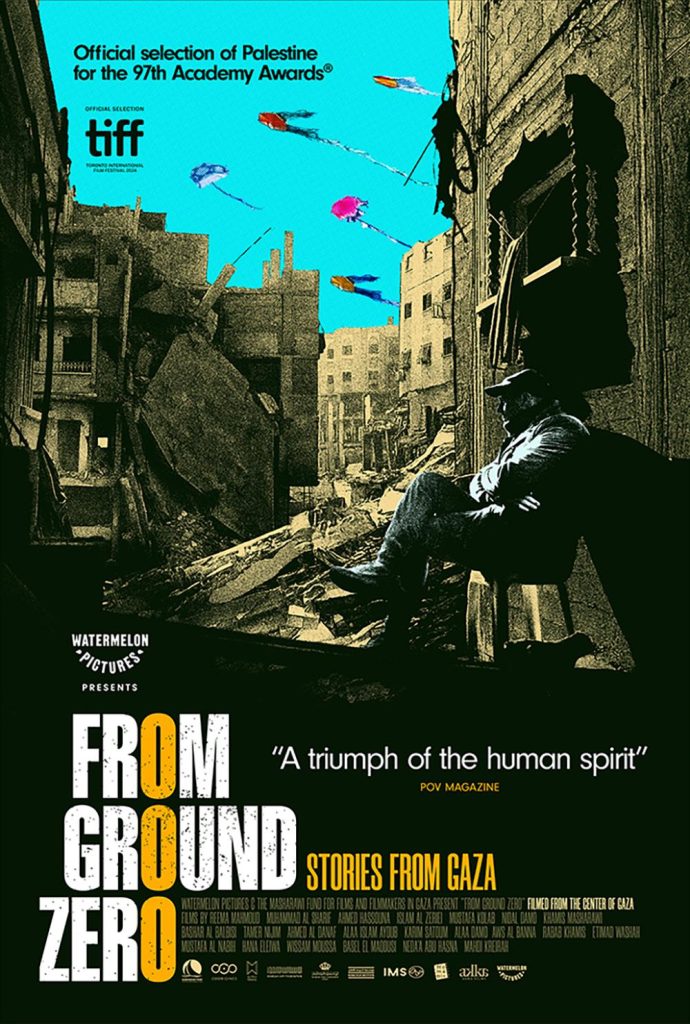
A week later, I went again to a Rialto matinee for a one-day showing of From Ground Zero, a compilation of 22 stories by Palestinian filmmakers/journalists and recently executive-produced by Michael Moore. It was shortlisted for Best Foreign Film and did not make the cut for an Oscar nomination, but it should have.
The artists who made these short films have been displaced, injured, watched their own children die in front of them, and yet they somehow conjure the professionalism to pick up a camera and record their people’s unique yet universal stories from amid the ruins of Gaza.
Israel has not allowed outside journalists to enter the land it occupies, so all these films were made by local people, women, teen-agers and those with jackets labeled PRESS. (According to the Committee to Protect Journalists, over 170 journalists and media workers in Gaza have been killed in the Israel-Hamas war).
In experiencing the mini-features of From Ground Zero, we witness young children making animations about their lives from cut paper figures and one professor’s day-long unsuccessful search to find a place to fill his water jug and charge his phone. We see the remains of paintings and sculptures produced for a young woman’s graduate exhibit, until the university was leveled. She wanders through the mess that was left of her home, picking over broken framed paintings, dust-covered drawings and sculptured doves of peace covered in pearls. We see a preteen who wears her headphones constantly to drown out the incessant buzz of drones so she can dance to her music alone in a dusty, pot-holed street.
It was a bit overwhelming to take in so many photographs of Gaza’s mass destruction on the large screen. These were coupled with images of miles and miles of tent cities erected on sand. There are no pictures, of course, of what neighborhoods in Ramallah or Khan Yunis looked like before the bombs and missiles fell, when there were families living together in multi-story buildings with communal kitchens and gardens, where they shared a meal after the Ramadan fast, where they celebrated weddings and births. Instead, a young man slumps on a chunk of concrete amid twisted rebar, mourning his dead fiancée.
Read here an excellent interview with filmmaker Rashid Masharawi, the director—or rather curator—of From Ground Zero. He says:
“This is a platform [for Palestinians] to show the world what is happening to the children of Gaza, the impact of the lack of aid and the lack of food being able to get in.” In the face of both physical and cultural genocide, “we are trying to make cinema, to deal with art, with culture. In spite of all what happened, we were trying to search for hope.”
MORE:
https://www.democracynow.org/2025/2/18/basel_adra
Interview on Democracy Now about No Other Land before the Oscars
https://www.democracynow.org/2024/10/3/starving_gaza_documentary
Starving Gaza another powerful film, can be found on YouTube.
So much injustice and cruelty. The stories of the Palestinian genocide, ethnic cleansing and systematic oppression have been censored and suppressed by powerful forces.
Jenny,
It’s wonderful to find you online. blast from the past–I was at CST from 1965-1969 and marched downtown Winona with you. I protested with your boyfriend and was friends with the guys at the farmhouse, especially Bob Fiscella. Would you have any contact info on Bob that you could send me please? I spent tons of time with Sue Dobbins, riding around Winona on a tandem bike and in the smoker in Lourdes Hall. (You might know that she’s passed). You were a big positive influence on me, and I’m grateful.
You’re doing amazing work–thank you. I’ve worked as a psychologist and am closing my private practice next week, refiring, not retiring :-). Planning to move to SC where my son and only child lives.
Warm wishes always,
Jeanette