
[Blog Post] I publish an excerpt of my father’s war memoir
How often on the third Sunday in June I think of the father of my grandson rather than my own father because my son-in-law, Tom Sepanski, is alive and Joseph Richard Orvino is not. Daddy died of colon cancer, metastasized to his liver, right around Christmas in 1994. He was five years younger than I am now.
Some of the poems I have written about him reference our opposite political views during the 1960s. As a medical officer in WWII who received purple heart and silver star medals, his position was “my country right or wrong” and mine was… well, to quote e.e. cummings, “I will not kiss your fucking flag.”
I can’t help thinking, though, that in a time when a twice-impeached, four times indicted, and finally convicted felon will be the Republican nominee for president, my father and I would be politically aligned. In fact, he’d make a better leader than half the men in public service today, including two members of the Supreme Court.
Joe Orvino was a man of integrity and honesty, a highly-respected attorney in the Chicago suburb of Melrose Park, Illinois. As a Catholic, he wouldn’t handle divorce cases, but took pride in adoptions and other areas of family law. As a pre-teen, I would often visit his office, which was only a city block away from the business district flat where I grew up. He’d let me type on his massive IBM electric and hang out with his partner, “Uncle” Barney Bruno (rumor had it Mr. Bruno represented members of “the mob”). Then we’d have a father-daughter lunch at a local joint, where he was often hailed by the owner and patrons alike.
I included a poem titled “Hero Daddy” in my 2012 book, Poetry, Politics & Passion. The heroism I praised in that remembrance was not as much about my father’s bravery in rescuing wounded men on a battlefield in France, where a jeep explosion cost him the sight in his right eye and the hearing in his right ear. It was about how he survived without (visible) signs of post-traumatic stress to marry his beautiful high school sweetheart and raise a family. He made sure we had what I thought of as “an upper middle class life” —with plenty of food, health care, private schools and vacations.
About 20 years ago, my brother sent me a sheaf of type-written legal-sized sheets that either my father gave him or he found after Dad’s passing. It was about 22-year-old Joey Orvino’s experiences in what he later referred to as The Big War. “He typed faster than his secretary,” my brother said, so we assumed that this was his memoir, started decades after the incidents described. Daddy said the story he was telling “ended so abruptly, because I got blown up.”
Did I get my penchant for writing, documenting, and journaling from sharing my father’s DNA? Whatever the case, in his honor, this Father’s Day, I want to quote an excerpt from these precious pages.
“The big breakthrough from Normandy through France by the allies was stopped at the Ziegfried Line for lack of supplies. That is why it is so imperative that Antwerp be cleared for use as a supply base for all allied armies on the Western Front.”
We all listened intently, grateful for the information. It always helped to know where you were going, and why. Major McGinnis was an excellent officer in that he always made every effort to acquire as much official data as he could for us. Division and Regimental Headquarters very often neglected to give the Medics more than mere basic information…
The next morning we, who were ear-marked for rail transportation, marched to La Haye du Puits where we were to board trains. When we arrived at the large freight yards, we saw no passenger coaches, but we did see freight cars which were about half the size of our American box cars. These we soon learned were to be our means of transportation. They were the dilapidated “40 and 8” freight cars which the veterans of World War I often spoke about. They were marked in faded lettering “40 Hommes 8 Chevaux.” In other words, 40 men or 8 horses.
The order went down the line to climb aboard. One officer and 39 men to each car. My entire medical section, plus a few infantrymen scrambled into the ridiculously small car. We soon learned what sardines must have felt like.
There was a terrible jerk, the car shuddered, and the train began to move slowly. After taking off our field gear and making ourselves as comfortable as possible under the circumstances, Gates and I shut the sliding door. Even with the door closed the car was cold and damp with the wind whistling through the many huge cracks. It was impossible to lie in a prone position. We discovered that by sitting between each other’s legs we could achieve a fair degree of comfort and also use the other fellows chest for a pillow…
By nightfall, when we had become pretty well adjusted to the routine, we evidently hit a long stretch of good track. The train had made no stops for hours. As we lay in our cramped quarters, sleeping fitfully, it became necessary for one or more of us to climb over our sleeping comrades and urinate out the door.
I was half-asleep on Gates’ chest when the big Sergeant struggled to his feet.
“’Scuse me, Lieutenant. I got to piss so bad I can taste it,” he whispered, and started to make his way towards the door. I saw his huge form silhouetted in the opening as he relieved himself.
“Get your damn foot off my head, Sarge,” cried a voice at Gates’ feet.
“Hold still, you bastard, can’t you see I’m pissin’?” rasped Gates.
The situation was hilarious and made us forget our discomfort for the moment.”
–from an unfinished memoir of Joseph Orvino (1922-1994) father of Jennie–
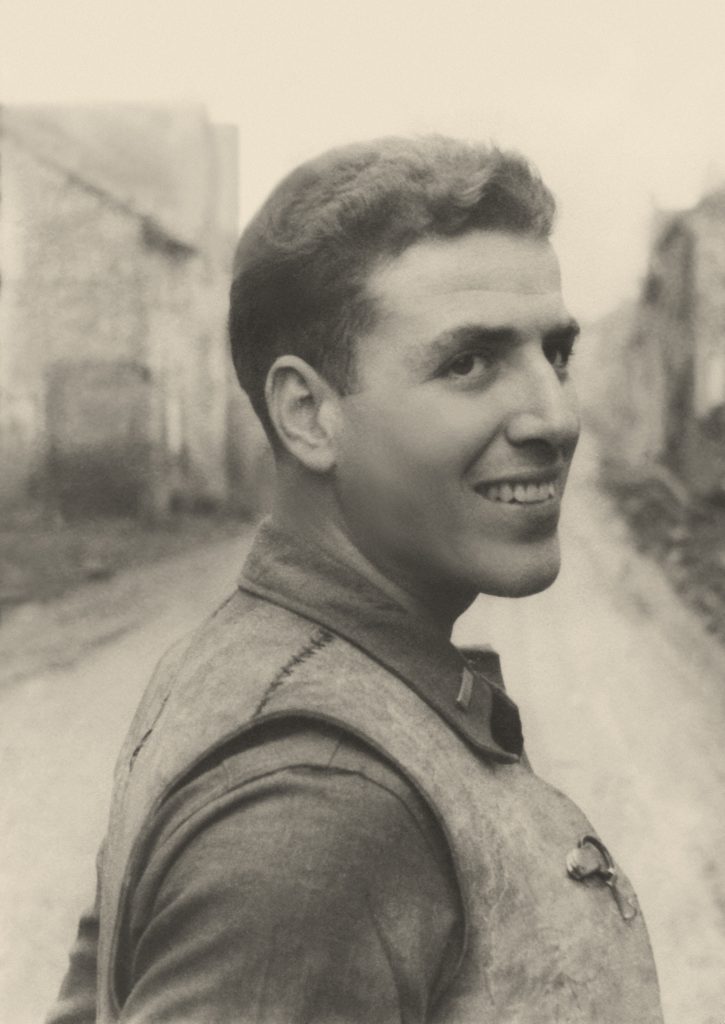
Joseph Richard Orvino (age 22) serving in WWII, 1944
What a precious gift from your brother and a beautiful tribute to your father Jennie. And I see where you got your good looks!
Thanks, Fran. I can thank Daddy for my naturally curly hair and my tendency to have receding gums! 🙂
Interesting. My father was a medic also. He was in the Navy, stationed in Hawaii for the duration. His last station was on top of Diamond Head which was a radio relay station. That unit received news of Japan’s surrender before President Truman because their unit relayed it to the Mainland. I thought your father’s story was both humorous and possibly sad. It struck me that the same cars may have been used to deport Jews to concentration camps earlier in the war. I’m pleased he didn’t suffer post-traumatic stress due to the war and/or his injuries.
I also thought about the transport of Jews, Romani, homosexuals to the death camps in railroad cars which is why I picked this excerpt from the 33 legal-sized pages of my father’s unfinished manuscript.
Hi, Jennie. Very nice work. From the photo–handsome devil–I see the resemblance.
The cummings quote reminded me of what is perhaps my favorite line of all: “I’d rather have my country die for me.” (Jefferson Airplane) Not to mention my brother’s response to his draft book inquisitor: “The enemies of this country are my brothers and sisters.”
They always said I was my father’s daughter and called me “Little Joe” for a while.
Thanks for sharing this, Jennie. Quite a guy – and you definitely inherited his gift of painting word pictures…